
Installation, repairs, spring start-ups and winterization — with programming that reflects what your lawn actually needs rather than a factory default.
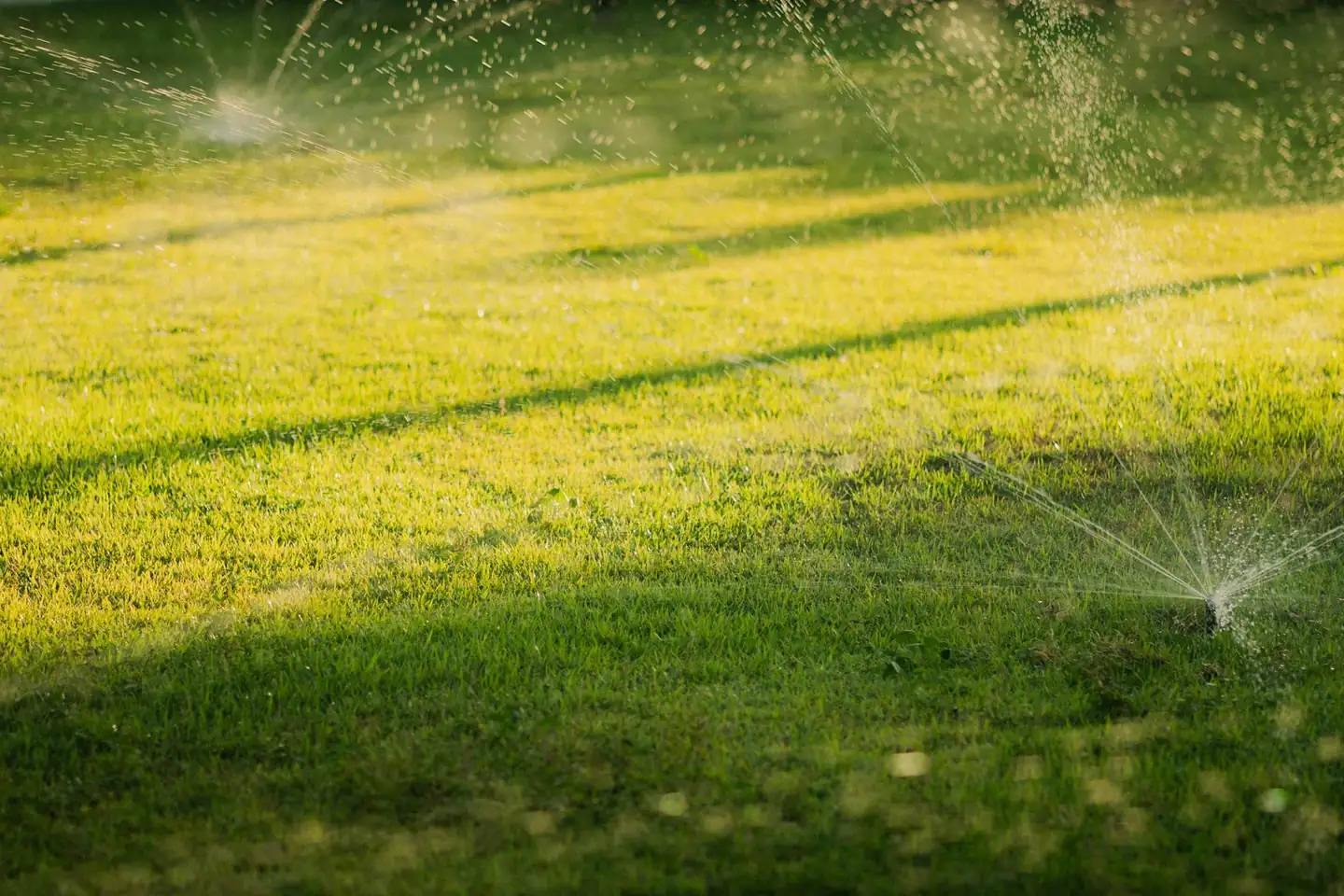
Most irrigation systems in this county are running badly. Not broken — badly. Watering daily for ten minutes when they should water deeply twice a week, running through rainstorms because nobody wired the sensor, spraying a fence and a stretch of driveway, or following a program set once at installation in 2011 and never adjusted since.
Watering deeply, not often
Short daily watering trains grass to keep its roots at the surface, where they are the first thing to die in a July drought. Long, infrequent cycles push roots down. For an established Bucks County lawn that generally means roughly an inch of water a week including rainfall, delivered in one or two soakings, ideally in the early morning so the blades dry before evening and you are not incubating fungus.
On clay soil there is a wrinkle: applied faster than the soil can absorb it, water simply runs off. The fix is cycle-and-soak — several shorter bursts spaced apart within the same watering, so each one has time to sink in. Most controllers can do this, and almost nobody has it set up.
What we handle
- Spring start-up — charging the system slowly, checking every zone, adjusting heads that have drifted or been hit by a mower, and reprogramming for the season.
- Winterization — blowing the lines out with compressed air before the first hard freeze. Skip this in Pennsylvania and you will be replacing cracked pipe and heads in spring.
- Repairs — broken heads, cut lines, failed valves and solenoids, wiring faults, controller problems.
- Rain sensors and smart controllers, which pay for themselves quickly and stop the neighborhood from watching your system run through a thunderstorm.
- Zone and coverage corrections, so you are not watering the sidewalk.
- New installation, designed around your actual planting beds and lawn areas rather than a generic grid.
Backflow and township rules
An irrigation system connected to a potable supply needs backflow prevention, and several water authorities serving Bucks County require annual testing by a certified tester. It is a small job that protects the drinking water in your house, and it is worth knowing whether your system has a device and when it was last tested.
What We Promise On Every Job
- We answer the phone. Miss us and you hear back the same day.
- Written estimate within one business day of walking your property.
- A message the day before every scheduled visit.
- Something not right? We come back — no argument, no charge for the trip.
Common questions
When should the system be winterized?
Before the first hard freeze — generally late October into November in this county. Earlier is safer than later; the cost of being late is cracked pipe.
How much should I be watering?
Roughly an inch a week including rain, in one or two deep soakings, early in the morning. On clay, split each into several shorter bursts so it soaks in rather than running off.
Can you take over a system someone else installed?
Yes. We service whatever is in the ground regardless of who put it there.
My water bill jumped. Could it be the system?
Very possibly — a stuck valve or a cracked underground line can run for weeks unnoticed. Worth checking quickly rather than waiting for the next bill.
Do I even need irrigation here?
Honestly, many lawns in this county do fine without it. A healthy, deeply rooted lawn will go brown in a hot dry August and come back in September. Irrigation matters most for new plantings, new sod, and people who want green through the whole summer.
Tell us about your property
Get the system working properly
Start-up, winterization, repairs, or a full review of what your controller is actually doing.
Often needed alongside this
We work Bucks County only, within about twelve miles of Langhorne, including Newtown, Yardley, Holland, Richboro and Northampton. See every town we serve →