
Wet lawns, standing water, and water finding its way toward the house. Usually the actual problem underneath a list of other problems.
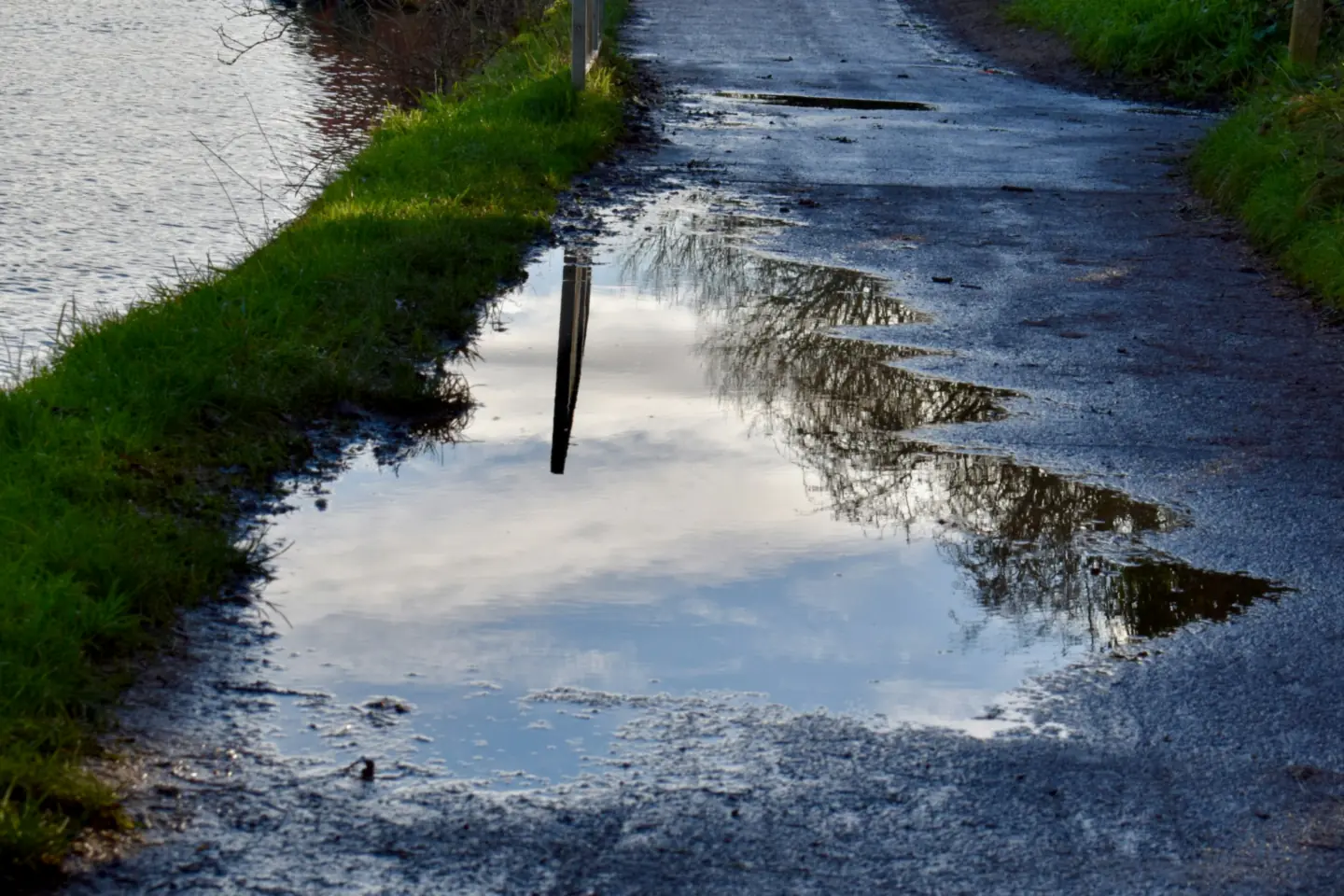
Drainage is the least visible thing we do and frequently the most valuable. A surprising share of what homeowners here describe as a lawn problem, a dying-shrub problem, or a patio-settling problem is really water going somewhere it should not, and no amount of seed, mulch or pavers fixes it.
Why Bucks County has this problem so often
Two reasons, and most properties here have at least one.
The first is soil. Heavy clay through much of Lower and Central Bucks drains slowly by nature. Water that would disappear into sandy soil in an hour sits on clay for a day, and once the soil is compacted it may as well be concrete.
The second is age and grading. The post-war developments — Levittown, Fairless Hills, much of Bristol Township — were graded seventy years ago, and seventy years of settling, added patios, extended driveways, new sheds and raised beds have quietly changed where water goes. The original design sent it away from the house. Many properties no longer do.
What we install
- Regrading so the ground actually falls away from the foundation. This is the first thing to check and often the entire fix — no pipe, no gravel, just correcting the surface so water leaves.
- French drains — perforated pipe in a stone trench, wrapped in filter fabric, carrying underground water out to a lower point where it can surface and run away. Genuinely effective when correctly built, and useless when the fabric is skipped or the slope is wrong.
- Downspout extensions and buried lines, carrying roof water well away from the house instead of dumping thousands of gallons at the corner of the foundation.
- Dry wells where there is nowhere for the water to run out to.
- Catch basins and surface drains for genuine low spots that cannot be graded out.
- Swales — shallow shaped channels that move water across a property without looking like drainage infrastructure.
- Rain gardens, where a wet area can be turned into a planted feature rather than fought.
How we work out what is wrong
We would far rather see a property during or just after heavy rain than on a dry day, because that is when the answer is obvious. If you have photographs or a video of where the water pools and which way it runs, they genuinely help.
Then it is the unglamorous part: where the downspouts discharge, what the grade does in the first ten feet around the foundation, where the neighboring properties send their water, how compacted the soil is, and whether there is an old drainage system that has silted up. Quite often the culprit is a downspout dumping at a corner, and the fix is inexpensive.
What We Promise On Every Job
- We answer the phone. Miss us and you hear back the same day.
- Written estimate within one business day of walking your property.
- A message the day before every scheduled visit.
- Something not right? We come back — no argument, no charge for the trip.
Common questions
Water gets into my basement. Can you fix that?
Sometimes, and it is always worth trying from outside first. A large share of basement water is surface water that was never given anywhere else to go — bad grade, downspouts discharging at the foundation, a patio pitched the wrong way. If the problem turns out to be below the slab or in the foundation itself, that is a waterproofing contractor’s job and we will tell you so rather than sell you a trench that will not help.
How much does a French drain cost?
It varies with length, depth, access and where the water can go. What we will not do is quote it over the phone — this is the service where guessing without seeing the property does the most damage.
Will regrading alone fix it?
Often, yes. It is the cheapest fix and the first one we look at. Pipe and stone are what you do when the surface cannot be corrected on its own.
Do you need a permit?
Usually not for residential surface drainage, but stormwater rules differ between townships and larger work can trigger them. We check before we quote.
Can you fix a wet spot in the lawn?
Usually. Sometimes it is drainage, sometimes it is compaction that aeration will resolve, and occasionally it is a plumbing leak. Worth diagnosing before spending money on the wrong one.
Tell us about your property
Find out where the water is actually going
Free assessment — and if the fix is a fifty-dollar downspout extension, we will tell you that.
Often needed alongside this
We work Bucks County only, within about twelve miles of Langhorne, including Levittown, Croydon, Morrisville, Fairless Hills and Bristol. See every town we serve →